navbar

Wednesday, 30 July 2014

Strange Meeting by Susan Hill

Synopsis:

 In 1914, John Hilliard, reticent and aged from his inaugural experiences of the war thus far, is haunted by nightmares whilst on sick leave. Hilliard is disillusioned with those at home for their naive ignorance and detachment from the grim reality of war. Upon returning to France Hilliard meets David Barton, an exuberant new recruit not yet sullied in battle or from the atrocities of war.

Hilliard, previously so reserved and detached, cannot grasp why he is so instinctively drawn to Barton, whose openness and magnanimity is as foreign to him as the backdrop of the French battlefields. The bond between the two men soon deepens into an ambiguous love - one which Hilliard cannot articulate even to himself - and one which is perpetually in threat of being destroyed through separation in death, with the prospect of being killed in battle ever present.

 Thoughts:

What resonated with me most throughout my reading of Strange Meeting was the stillness to the narrative, imbuing the novel with a sense of poignancy - the futility of war when looked at against the backdrop of senseless death. Susan Hill doesn't engage the reader in elaborate battle scenes, nor does she concern her story with the minutiae of war. Instead the narrative is focused on its trivialities (in comparison to bloodshed and political manoeuvrings) - which are therefore mundane, such as that felt by Hilliard in the 'rest periods' of soldiers on leave. 

Deaths in Strange Meeting are by nature accidental and trivial. No one passes in a blaze of glory, no harrowing scenes of bloodshed and no closure. This serves to permeate the narrative with a numbness and begs the question - what is the point? Hill brilliantly turns traditional historical fiction towards the psychological impact of war - the isolation felt by Hilliard when he is back 'home' (not to mention the irony that home has become the battlefield with his fellow men), or the brilliance of Barton's gregariousness cruelly stolen by war and replaced with an almost tragic numbness.

Of course the crux of Strange Meeting is the relationship between Hilliard and Barton. An ambiguous love or at least a deeply strong mutual attachment, develops out of an unconscious need from each man. Hilliard, already aware of and succumbed to the atrocities and futility of war is in dire need of hope - a reason to continue, an emblem to prove that their endeavours are worth it. Barton is this emblem, shiny and new without the taint of battle. On the other hand Barton is naive and artless in the ways of war. Hilliard, for all his experience and wisdom provides the grounding and guidance Barton will need.

Strange Meeting never makes the relationship explicit - to either Hilliard and Barton or the reader. Whether it will be physically realised lingers silently at points, though Hill is careful not to steer the reader towards this presumption. Instead the relationship is innocent and undergoes a role reversal, with both Hilliard and Barton becoming what the other was to him. Barton, upon losing his brilliance through experience, becomes world weary and dejected to the dismay of the now rejuvenated Hilliard. 

Strange Meeting is a poignant tale of deep rooted friendship in WW1, with a rich narrative focused on the triviality of loss.

Sunday, 20 April 2014

Once (2007) - Film Review

once film poster, once film review, glen hansard, once film
Starring: Glen Hansard and Markéta Irglová

Synopsis: 

An affable Dublin street busker/hoover repairman (Glenn Hansard) catches the attention of a young Czech migrant. Drawn in by the raffish charm of his music, the girl (Markéta Irglová) encourages him to take his talent seriously. Still lovesick over his ex-girlfriend and she conflicted over her absentee husband, the pair embark on a mutual labour of love, recording the street buskers songs with a view to success.

Thoughts:

Once is a charming, low budget film (approx. €130,000) told with heart. With a down to earth, fly on the wall style, it reads like a documentary of two people who help recognise the potential in one another. A simple story, the charm lies in its two protagonists - unnamed but so understated and likeable. There is obviously a tender connection between the pair but Once refrains from following the clichéd route of inevitable romance. Instead the film leaves us with the enduring message that some people are right for us at certain times in our lives, to help us move on - a helping hand along the way to where we're going.

Once has an almost impoverished feel to it, set to the rain dashed cobbled high streets of Dublin, the bare, rudimentary flat of Irglová's character and filled with humorous pathos characters such as a down on his luck(!) mugger, Once has an unmistakably rakish charm. With original pieces sung by the two leads, the soundtrack brilliantly follows their time together, charting their creative collaboration.
(Songs including "When Your Mind's Made Up" and "Falling Slowly" are reminiscent of the now defunct collaboration of Damien Rice and Lisa Hannigan).

With its down to earth authenticity, Once is a return to the simplicity of storytelling, quietly celebrating the joys of music, gritty determination & friendship.

Sunday, 13 April 2014

Breathe In (2013) - Film Review

breathe in, film review, felicity jones, guy pearceStarring: Felicity Jones and Guy Pearce

Synopsis: When the poised and reserved English exchange student Sophie (Felicity Jones) moves in with her American hosts, the Reynolds family, for a term abroad, she finds herself warily drawn to  rakish patriarch Keith. A music teacher and occasional cellist for the Manhattan Symphony Orchestra, Keith silently pines for his former days of creative and musical glory.
The pair maintain a mutual distance from one another that's both reticent and cautious - until Sophie reveals herself as a musical virtuoso - a brilliant pianist who calls to Keith in a way his present life can't.
  
Thoughts:
 
Breathe In has a languid fragility to it, atmospheric for the use of natural mood lighting and devoid of over-dramatisation. Much like Drake Doremus's previous Sundance offering Like Crazy (also starring Jones), the film is intimate, with authentic performances from the cast who rely on improvisation than any solid script. Whereas the conversations are not always so free flowing, even stilted at times, it lends a dramatic 'realness' to the story that's refreshing in comparison to more eloquent cinematic dialogue.

felicity jones, breathe in film, film reviewFelicity Jones' character is very reminiscent of that which she played in Like Crazy (I didn't actually know both films were from the same director till after watching Breathe In, having seen Like Crazy the previous year!), with Sophie carrying an air of aloofness that's both endearing to the character of Keith and the audience. I wouldn't say there's much to differentiate Jones' performances in both films but it's clear that Doremus is monopolising on her talents for understated drama.

One of the opening scenes plays with foreshadowing, depicting the close knit Reynolds in their quaint, rustic home playing a game of Jenga, hinting at the collapse of the family - strong at first but with weak foundations. Perhaps an obvious motif, but one that certainly sets up the story in one clear image. In fact with the film centered around music, it's only fitting that the story seems to follow the trajectory of a typical classical piece. Starting languidly, once the pull between Sophie and Keith begins to grow stronger and it's apparent there is a spark between them, the drama heightens and builds to its climatic crescendo.

For the characters, everything is pushed underneath. Keith lives out pockets of former glory as his time subbing for the symphony orchestra in between what his wife Megan (Amy Ryan) regards as his 'real' vocation - teaching. Derivatively referring to his passion as a 'hobby', a sense of inertia is at play within the family. Content with stability, it's ironic that Megan is the one to bring Sophie into their home - the quiet storm that soon creates tension between all family members.

guy pearce, breathe in film, film review
The burgeoning relationship between Keith and Sophie is less passionately charged than the usual films of this ilk. The tension is there but less palpable and heightened than it could lend itself to be. Likewise, the character of Sophie is watered down - an enigma, but a pale version - she's almost hapless in a very unfortunate way. Lending herself unintentionally to teenage gossip, we see a vulnerable side to her. Comparing this with scenes where she is more in control - i.e. playing the piano defiantly or else reveling in the hold she has on Keith - it's difficult to say what Breathe In intends for her to be. Obviously an outsider, preferring to read Jane Austen at pool parties than mingle with her peers, Sophie is the quintessential 'complicated' female protagonist - a pale, more muted version of the manic pixie dream girl.

With the added bonus of Dustin O'Halloran's ethereal and atmospheric score infusing Breathe In with a moody and fragile ambiance, this is an understated and raw offering from Doremus.

Sunday, 6 April 2014

Goodbye First Love (2011) - Film Review

goodbye first love, un amour de jeunesse, film review, lola cretonStarring: Lola Creton and Sebastian Urzendowsky

Synopsis: Set in early 00s Paris, Goodbye First Love (Un amour de jeunesse) chronicles the 8 year long on and off again relationship of Camille and Sullivan, spanning their late teenage years to the onset of young adulthood. The film is a tender and intimate look at the dynamics between the couple, with Camille both petulant and needy in her lovesick state and deeply resentful of Sullivan when he announces plans to travel abroad. Heartbroken for what she perceives as abandonment, Goodbye First Love follows Camille and Sullivan as they discover who they are, together and apart.

Thoughts:

Goodbye First Love is much more Camille's story than Sullivan's. Once Sullivan leaves for his travels, much of the film is committed to the paths Camille follows in her attempt to forget and grow without him. Taking on a hotch potch of jobs without any real meaning or connection, we follow Camille as she trains to become an air hostess, her time as a tacky club rep and finally her settling to a career in architecture. Seemingly the lost soul of the story for wandering aimlessly from one vocation to the next, it is Camille who is very much her own driving force.


Whilst Sullivan is in South America in his self proclaimed state of self-discovery, Camille does the same in the very milieu Sullivan found so cloying. Here is the bittersweet realisation that ironically, for all his aloofness and detachment, it is Sullivan who doesn't know what he wants. However it seems Camille is always looking for Sullivan. Whereas she asserts her independence and identity away from their relationship, his impending returns are marked by an almost physical regression. Whilst sporting a suitably Parisian, gamine cropped hair style during their time apart, Camille's hair grows back to its rakishly longer style, hinting at the juvenility of first love. Alone she is stronger and less reliant on the affection of another. The cropped hair signifies the shedding of her former self - the one interminably tied to Sullivan.


goodbye first love, un amour de jeunesse, film review, lola creton  Lola Creton wears melancholy with an exacting, Parisian-esque manner. Needy and attached, the rest of the world including her mother and father in their loveless marriage and even the aloof Sullivan, are benign in comparison. With this the film captures the all too familiar teenage angst of young love, but without vanity and with just enough self indulgence to let us empathise with the characters. Whereas we can appreciate Sullivan's need for exploration and his aloofness at Camille's capricious nature and impetuous moods, we also sympathise with her resentment at his detachment.

Set to the backdrop of bohemian Paris, with its artsy apartments or else idllyic countryside locations, with a gorgeous soundtrack including the languorous 'The River' by Johnny Flynn and Laura Marling, Goodbye First Love has a delicate feel to it, hard to grasp and articulate - perhaps a bit like the tenuous bond between Camille and Sullivan.

Sunday, 23 February 2014

What Richard Did (2012) - Film Review

Starring: Jack Reynor, Sam Keeley and Lars Mikkelsen

Synopsis:

Loosely based on true events, What Richard Did is the story of a Dublin teenager on the cusp of manhood. Richard Karlsen (Jack Reynor) has it all - the adoring family, the awe and respect of his peers as captain of the rugby team and the prospects of a carefree summer before university. When newcomer to the scene Lara catches Richard's eye, his friendship with fellow teammate Conor (Sam Keeley) becomes tenuous when it's apparent Richard isn't the only one to notice Lara. Struggling to accept the friendship between Conor and Lara, Richard's jealously grows, albeit in an initially passive-aggressive manner.What unfolds is a story of unprecedented violence and guilt that is haunting for both Richard and the audience.

Thoughts:

What Richard Did is essentially a "fall of a hero" tale. Richard is the archetypal hero figure - the golden boy of his milieu. He's the stereotypical apple of his parent's eyes (especially his fathers, which only sets him up for a greater fall when events unfold), looked up to with awe and respect by the younger members of the rugby clique and fawned over by girls. Richard however is not one who carries this admiration with arrogance. He is well mannered and polite to his elders, protective over the younger members of his social circle and displays many instances of good intentions.

When the character of Lara is introduced, we begin to see cracks in Richard's initially stellar character. When it becomes apparent that Conor is still very much in the picture for being Lara's friend, an underlying current of jealousy is evident in Richard's demeanour. Where overt hostility could be employed from the offset, the played down insincerity with which Richard treats Conor is all the more unsettling. The tension is palpable, especially for the passive-aggressiveness from Richard's side compared to the continually good-natured Conor.

When the film's title lives up to its name, Richard's means of coping with the fall out is much more telling of his character. Essentially it seems Richard's biggest character flaw is his ego and the need to be seen in a positive light. His behaviour breaks down in a subtle but meaningful way thereafter and it is this development (or reversal of) that is endearing to watch play out.

What Richard Did examines the idea of a person's true nature given the right circumstances. When guilty, Richard is more cold and calculated, his main drive being for self-preservation. Yet despite this, he still expresses remorse. At the heart of his character, Richard does seem a 'good' person - so should he be condemned for this one anomalous yet reprehensible act? Here the lines of morality are blurred and this is where What Richard Did sparks an interesting debate.

Richard could be easily portrayed as unlikeable and arrogant for his status and privilege. The question that does bear considering is whether Richard's upbringing has inevitably given him a sense of entitlement that stretches into his personal relationships. There is an element of hubris to the character, evident in the way Richard cannot fathom why Conor doesn't concede to his failing to win Lara by stepping aside and breaking off contact. Without this, how can Richard display himself as the 'better man'?  What Richard Did however, doesn't depict any stereotypical, debauched behaviour to hint that Richard's actions are typical or a product of his upbringing. The mistakes and actions dealt with in What Richard Did are universal and transcend environmental and social influences.

The cinematography is understated, relying on natural light to create a sense of stillness throughout the film. This helps develop the idea of  'the calm before the storm', hinting towards something more terrible impending. With the absence of artificial lighting, there's an intimate element to the film, with much of the story set in the languid hours of the day. Moody and poignant, the story becomes more true to life for its reliance on authenticity.


My one gripe with What Richard Did is the lack of character development for Conor. The film gave little to no elaboration to his background and much is left to speculation. Conor is depicted as more obviously vulnerable than Richard, slighter in build and more gentle in his mannerisms. The film only hints at personal issues, yet all we are left with is the impression that Conor is as much the 'good guy' as Richard apparently is. Although Conor is a likeable character treated with sympathy, it's difficult to say whether there would be much satisfaction from seeing Richard brought to justice (i.e. prison).


What Richard Did is an exploration of morality and guilt. An observation into the subsequent fallout of one boy's terrible act, when there is little redemption or justice.


Tuesday, 18 February 2014

Shame (2011) - Film Review

Starring: Michael Fassbender and Carey Mulligan.

Synopsis: Brandon is desperately addicted to sex and porn. A successful New York businessmen, he projects a facade of suave composure to his friends and colleagues.The unceremonious arrival of estranged and dysfunctional sister Sissy threatens the picture of stability and success Brandon has constructed for himself. 

Thoughts:

We are introduced to Brandon against the backdrop of a grimy New York subway. Assiduously dressed in fitted coat and cravat-styled scarf, he's incongruous to the dirt smeared windows; a contrast to the sloven homeless man slumped in the opposite seat. His shame - inevitably reviled by society - is worn openly. Here we have just one example of the enduring irony employed in Shame. Brandon's shame is private and tortuous. Shots of Brandon staring lingeringly up at exhibitionist couples through windows emphasises Brandon's isolation. He alone seems to be incapable of wearing their deviations openly.

The audience is granted an intimate look into Brandon's perversions. Whilst this is uncomfortable for the subject matter at hand, the irony is again evident when played against scenes with a co-worker who Brandon develops 'real' feelings for. Connecting on an emotional level creates a mental and physical block, making Brandon a figure of pity and hopelessness. Shutting the world out on any meaningful level, the audience are the only ones privy to Brandon's personal life.

It's unsettling to see how ordered and meticulous he is in his daily life. Ritualistic to a tee, the arrival of emotionally erratic Sissy (Carey Mulligan) threatens Brandon's grip on what he can control. Although never elaborated on, instead relegated to an invisible storyline for the audience to ruminate on, Brandon and Sissy are incapable of engaging in functional relationships. At the heart of this seems to be an inappropriate 'anti-bond', leaning towards incestuous undertones. The siblings are brutally exposed to one another, both physically and emotionally.

Sissy is damaged. Whether due to dysfunctional relationships of her own (scenes of Sissy pleading on the phone to an ex-lover are sad and pathos-like), she clings desperately to Brandon for scraps of affection. She is above all, vulnerable and despite her own distasteful behaviour, Shame depicts her as almost innocent and childlike. Shrouded in thin white material or in a glitzy ballgown singing a bluesy version of New York New York (in the films most gorgeous scene), Sissy seems to be the only character to appreciate hers and her brother's issues of misplaced intimacy. "We're not bad people. We just come from a bad place."

Shame is raw and brutal in exposing Brandon for his addiction. Whereas much of the film is muted in its colour pallete, emphasising the isolated world Brandon inhabits, colours are suddenly abundant and vibrant when Brandon succumbs or indulges in his addiction. The soundtrack is melancholic but hopeful and with the film's ambiguous open ending lending to audience speculation, that is all Brandon is left with. The possibility of rehabilitation.

Steve McQueen and Abi Morgan (both past collaborators with Fassbender - see Hunger and Fish Tank respectively) have created a brave, nonjudgmental portrait of a man isolated for an addiction many would look upon as perverse. Unflinching and unapologetic, Fassbender is on form in his portrayal of Brandon. The nuances of his personality - charismatic, suavely flirtatious, tortured for his impulsions - are perfectly executed, without a hint of melodrama and as composed as his character crafts himself to be.

Monday, 20 January 2014

Kelly + Victor - Film Review

kelly + victor, kelly and victor, film review, julian morris
Starring: Antonia Campbell-Hughes and Julian Morris.

 Synopsis:

After a chance meeting in a nightclub in their hometown Liverpool, strangers Kelly and Victor are instantly drawn together in a drug fueled haze. A one night stand sparks an intense dynamic between the two - one that shocks Victor yet inexplicably keeps him hooked. With their relationship darkly masochistic, Victor - discontent with the illegal exploits of friends around him - ironically becomes attached to the destructive bond he shares with Kelly. Likewise Kelly, who is largely isolated from the world, develops a brutal intimacy with Victor - yet it is one which is still hidden from anyone outside of the couple.

kerry+ victor, kerry and victor film, julian morris
Thoughts:

A lot is left to be desired with regards to the character of Kelly. Perhaps intended as an enigma, she's depicted as possessing a timid, ethereal quality that attracts the grounded Victor. Drawing him in with vague allusions to their match based on horoscopes, there's little insight into where her violent, masochistic inclinations come from. Matching this against a scene where she expresses reluctance to act as an accomplice to a fantasy game with a prostitute friend, the film seems driven to portray Kelly as a conflicted individual, with only the faintest allusions to her past.

Victor on the other hand is depicted as the weaker link. A grounded family man at heart, he is relatively more at home with societal convention, portrayed in more straightforward scenes of familial duty with his young nephew. There's a degree of inner turmoil as he tries to reconcile this life with the darker, closeted one he shares with Kelly. The implications aren't lost on the two, with Victor in particular conflicted by how grossly conspicuous and taboo their relationship is to conventional society. This ultimately reaches its inevitable breaking point with destructive results.

I would have liked a deeper psychological slant to the film but perhaps leaving it to the audience's imagination made it all the more unsettling. The relationship is closed off to the rest of the world, set to the cloistered backdrops of Kelly's claustrophobic flat or the quiet confines of an art gallery. With sparse dialogue and little character background, Julian Morris and Antonia Campbell-Hughes complement each other well. Morris's earthy characterisation against Campbell-Hughes' tenuous one dramatically highlights the self destructive element of their relationship.

Cinematography-wise, Kelly + Victor celebrates the quiet beauty of Liverpool. There's an emphasis on the simplicity and tranquility of nature where Victor feels most at peace, which only heightens the extremities of Kelly. Her scenes are eerily quiet, with the barest of details in the background, or else in extreme settings of hazy nightclubs and scenes of brutality and violence. With the addition of the brooding Bill Ryder-Jones score providing the ominous overtones, the theme of danger and taboo is apparent throughout much of the film.


A unique look at the dynamics of a deeply dysfunctional relationship. Kelly+ Victor is an intimate, yet uncomfortable portrait of two individuals drawn together in an intense addiction for masochistic gratification.

Sunday, 12 January 2014

Dear Lupin - Letters to a Wayward Son - Book Review

dear lupin, roger mortimer, charles mortimer, dear lupin book review, letters to a wayward son
"Dear Lupin" is the collection of delightfully witty and wry letters sent to Mortimer Jr. from his ever exasperated father Roger, a racing pundit for the Sunday Times. Chronicling the various scrapes and escapades Charlie finds himself in, Roger is always a source of sound advice, humorous anecdotes and world weary remonstrations in the vain attempt to keep his errant son in check.

 Much of this stems from the generation gap between father and son, with Charlie more at leisure to peruse the fruits of life more flagrantly than his father would like. Holidaying with deplorable friends or else dabbling in drink and drugs is at odds with the more mundane chagrins of Roger's life, including dull acquaintances at dinner parties, the excessive drinking habits of Charlie's' mother and the ever salient fact of growing old. 

"I had a bad and painful attack of gout last week and now I have a throat infection and am partially deaf. Getting old is revolting and I hate it."

  Roger Mortimer's letters never failed to make me grin with delight as he litters his correspondence with random digressions and stories of oddball relatives, the exploits of a family pet or the death count of a nearby car accident. Despite the numerous allusions to his disappointment towards Charlie's foibles and shortcomings, including many a failed (or lack thereof) attempt at respectability, Roger's affection for his son is never in doubt. As Charlie flits erractically from one job to the other, Roger is the steadfast guardian, never failing to be the constant in his son's life.

Surprisingly, Dear Lupin doesn't include replies from Charlie (or Lupin, the moniker handed to him by his father after the erstwhile son in Diary of a Nobody). Instead Charlie provides small footnotes letting us know what points in his life Roger is alluding to. These too are a small source of laughter, as Charlie plays the part of the hapless, wayward son with real life panache. The collection also incorporates a handy go to list of people and places mentioned throughout the correspondence.

Dear Lupin is a unique, heartwarming vignette of the relationship between a father and son spanning from the late 1960s onwards. Not only are we granted an intimate look at one family's idiosyncratic life, but also the social context in general. Roger Mortimer has a wonderfully acerbic and eloquent way of writing, infusing Dear Lupin with a sepia toned melancholy for the lost art of letter writing.
 

Note: Dear Lupin is just one of three collections of letters from Roger Mortimer, with Dear Jane: My Father's Life and Letters and Dear Lumpy: Letters to a Disobedient Daughter the two remaining installments in this familial saga of correspondence.

Sunday, 29 December 2013

The Place Beyond The Pines - Film Review

Starring: Ryan Gosling, Bradley Cooper, Eva Mendes and Dane Dehaan.

the place beyond the pines, ryan gosling, eva mendes, luke glanton
Synopsis:

Travelling stuntman Luke Glanton learns he is a father after a brief love affair but with no stable financial prospects to speak of is rejected by ex-lover Romina (Eva Mendes). Determined to prove his worth as a father, Luke takes up employment with mechanic and ex-bank robber Robin. Soon Luke picks up where his friend long ago retired, and begins a string of bank heists to provide for his son.

Bradley Cooper is Avery Cross, a local cop keen to live up to the prestige of his father, a respected judge. Struggling to climb the ranks of his career, Avery finds his moment of glory in the films pivotal moment, yet marred by his own dubious morality. When Luke and Avery's paths cross, the encounter sets in motion an emotional story of fathers and sons, morality and redemption.

Thoughts:

Although I adored this film beyond anything, it was one that I preferred not to immediately over analyse and critique. I instead ruminated on how seamlessly two separate narratives - one of the wayward stuntman Luke Glanton, pursuing a life of crime for the benefit of his estranged baby son, the other of morally dubious Avery Cross - weaved into the other. With a generational slant to the story, the two drastically different men leave a potentially devastating legacy to their respective sons.

What I loved above all were the beautifully understated performances from the cast. Ryan Gosling's character left a presence which lingered throughout the latter parts of the story, a ghostly remnant hanging over his troubled son, played by a poignantly weary eyed Dane Dehaan. Gosling's scenes with his infant son are tender and bittersweet, at odds with his harder, tattooed exterior. Possessing a fatherly instinct that is effortlessly innate and pure, Luke is still too wayward to provide the stability his son and Romina need. The film's subtle parallels between father and son are subsequently sad and uplifting, hopeful and helpless as we wonder whether history is doomed to repeat itself or whether it can exonerate those chained to its past.

the place beyond the pines, dane dehaan, jason

The Place Beyond The Pines has a voyeuristic style to it, with wide panning, sky high shots coupled with those closely shadowing characters from behind, almost as if the audience is acting as the silent moral conscience of the story. The cinematography is beautiful, with a sense of poignancy and sadness permeating the overarching themes of forgiveness, self acceptance and redemption. Coupled with a beautiful score including Ennio Morricone's Ninna Nanna Per Adulteri, The Place Beyond the Pines is one of those films hard to leave behind, perhaps best encapsulated by this quote from Dehaan - 

"People always say it lingers you know? Like I saw the film last night and it's still sitting right here."


A melancholic tale of dysfunctional family ties and the ambivalence in what can be defined as right and wrong, The Place Beyond The Pines carries a strong sense of fate and melodrama that suitably appeals to the emotions. A stand out offering from director Derek Cianfrance.


Sunday, 22 December 2013

Frances Ha - Film Review

Starring: Greta Gerwig
 
Synopsis:

27 year old Francis (Gerwig), an apprentice dancer, is at a loss when best friend Sophie announces plans to move out of their shared apartment. Floating through various living arrangements and piecemeal jobs in the year that follows, Frances becomes increasingly bemused at her lack of prospects compared to those around her. 


 Just as E.M Forster's 'The Longest Journey' quietly found its way into my life with its fortuitous timing (see blog post here), Frances Ha is my cinematic soothsayer equivalent. Millennials and 20-somethings alike would find this utterly relatable for its themes of quarter life restlessness. 

Frances Ha encapsulates the confusion and anxiety felt at the realisation that life is now a competition you had no wish to partake in - especially when it feels like you're losing. Friends who spend every waking moment with you now have plans that for the first time don't include you. Being in your 20s is now considered 'too old', or old enough to by now have a 'suitable job' and second homes.
As a twenty something Londoner, lacking the effortlessly cool apartment and hip neighbourhood to boot, I did feel slightly at a distance to the Manhattan setting and at times irritatingly carefree exploits of the characters. In one of her flippantly nonchalant moods, Frances takes off for a solo weekend in Paris. Bored and alone, the highlight of her Parisian foray is a call from erstwhile friend Sophie, holding out an olive branch to which Frances cannot commit to - being unceremoniously unavailable for flying out of the country on a moment's whim. (How she affords this when much of the film centers around France's financial woes was also to my chagrin). Nevertheless, I did like the whimsical nature of France's decisions, offset to her ever growing realisation that nothing goes to plan.

Her confusion at other people's sense of 'having it together' is both adorable and amusing and perfectly set to a dinner party, where acquaintances are married with second homes in France and express bemusement at Frances attempt to do the 'grown up thing' and ask ironically what their jobs are. This is offset with the more laidback table gatherings with flatmates Lev and Benji, who may not be quite as grown up but still leave Frances incredulous that everyone has it more together than herself. 
 
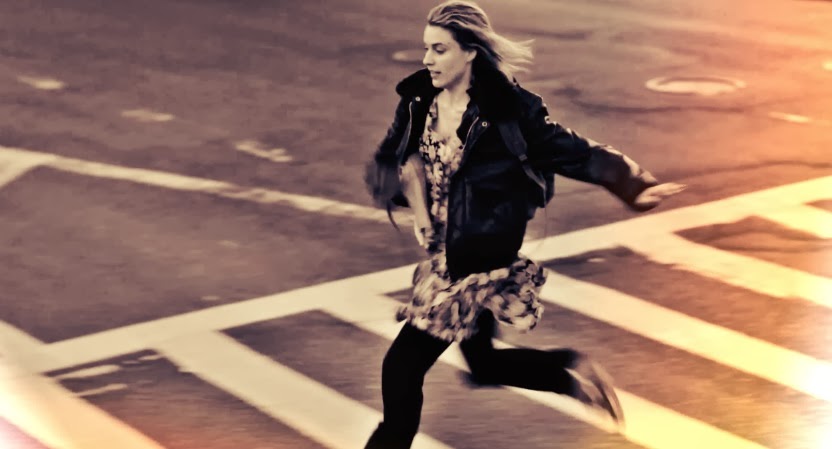
Greta Gerwig's performance is less frank and self aware as I anticipated it may be with my initial reservation that Frances Ha would be little more than a feature length episode of HBO's Girls. Instead Gerwig is awkward enough to be relatable, yet not so much to be irritatingly self complacent. With jubilous moments such as Frances running down the street to the score of Bowie's 'Modern Love', the carefree but wry element of Frances Ha is more visible for being shot in black and white.
 
 
 Have you seen Frances Ha? What were your thoughts?

Sunday, 8 December 2013

The Love of My Life by Louise Douglas - Book Review

the love of my life, book review, louise douglas, love of my life book 
Synopsis: After the sudden death of husband Luca, Olivia [Liv] finds herself bereft of her companion in life. Spurned by their families for the embarrassment and emotional ramifications of their ill advised union and subsequent elopement, Liv makes the gut wrenching decision to relocate back to where she and Luca first met. The Love of My Life is set to the picturesque beach front town of Watersford, home to Marinella's, the family restaurant and backdrop to Liv and Luca's early life, both together and apart.

With no family or friends to speak of, and only the almost tangible memories of Luca to console herself with, Liv finds solace in the company of the only Marinella who doesn't express disdain at her arrival - Marc, Luca's twin brother. In their desolation and grief, the pair develop a mutual need for one another, both physically and emotionally.
 
Juggling her grief and guilt whilst enduring the perpetual hostility of her in-laws, Liv begins a job as a research assistant at the local university, working for a taciturn professor on his controversial biography of a Watersford author. The Love of My Life takes us through Liv's past and present, both with and without Luca and her struggle to find her new place in life.

Thoughts:

Douglas has taken a straight forward plot, and stock characters (i.e. the death of a spouse, inhospitable in-laws, extra marital affairs) and shaken off the usual literary stereotypes and assumptions one would usually associate with them. For instance, the affair is refrained from being regarded as anything sordid or disrespectful to Luca's memory. Liv expresses guilt and remorse for her actions and her grief is at times all consuming to the point where it isn't a far stretch to feel sympathy at her situation. Isolated and chastised for her decisions, both in the past and present, Liv is almost a social pariah, judged for the indiscretions and mishaps of her youth that have doggedly clung to her reputation as an adult.

As the story progresses, Douglas flicks back and forth through Liv's timeline, alternating between the present, newly widowed state and Liv's younger self.  The narrative is at times melodiously written, which I found myself thinking was quite odd for a first person perspective - it seemed out of keeping with the accessible style of Liv's tone. However as the story reminds you towards the end, it is in fact a written log of Liv's life post-Luca. Upon this realisation, I appreciated Douglas's knack of commenting on the smaller facets of a scene to create a world for her character that we're permitted unfettered access to. I never felt it to be a biased narrative, as although Liv discusses what could easily be perceived as a checkered past (through noone's fault but her own), she has no qualms in accepting her blame where due.

I personally would have preferred a bit more development for the supporting characters. Much of what we have is from Liv's perspective and from her younger self we know that naivety is not always lacking. I was intrigued by Nathalie, Liv's sister-in-law and Marc's wife, who is especially thorny to Liv and her return. Although we are given justification and insight into her motivations and attitude, I would have liked more interaction between her and Liv. 


Have you read The Love of My Life?

Sunday, 1 December 2013

Dark Places by Gillian Flynn - Book Review

dark places, gillian flynn, book review, gone girlSynopsis:  

Libby Day is the sole survivor of the horrific massacre which claimed the lives of her mother and two elder sisters. Serving a life sentence is older misfit brother Ben Day. A reserved 15 year old, rumoured to have been associated with a satanic 'gang' at the time, Ben has yet to deny his involvement in the murders.

Having lived off the charity and monetary good will of the sympathetic, Libby has forged herself a reclusive (although not a content) existence. With funds depleting, Libby reluctantly agrees to make a 'special appearance' for the 'Kill Club' - a group of unsolved murder 'super fans.' Libby is initially embittered and dismayed to realise that the club is campaigning for Ben's release, believing him to be an innocent scapegoat for the massacre.

In exchange for cash, Libby embarks on a grim trip down memory lane, revisiting those connected to the events surrounding the murders. Already a dubious witness to the crime for being so young and most likely having produced a heavily scripted testimony, Libby pieces together exactly what happened and why.

** This Post Contains Spoilers **

My lasting impressions of Flynn's work is that she establishes and deftly maintains a strong thread of suspense throughout her narratives. As with Gone Girl, 'Dark Places' switches the perspective with each chapter, alternating between present day Libby, a sardonic and far from well adjusted adult, and the past Ben and Patty Day - the family's pallid matriarch - on the fated day in question.

What is admirable in Flynn's storytelling is her ability to run the present and past at parallels. She creates a slow building climb through the past, as it crawls out of cloaked truths simultaneously to Libby's own recent discoveries. She has a tight grip on the narrative, able to scatter events and scraps of information across the two timelines to converge at a watertight conclusion.
Ben possesses burgeoning resentment at what he feels to be the ever humiliating emasculation from living in a dilapidated, female dominated household. Ridiculed by his errant father for being effeminate, and constantly at pains from his mother to appease his sisters, Ben becomes quietly determined to assert his masculinity. Thoughts of 'annihilation', befriending a group of erstwhile drifters, including girlfriend Diondra and friend Trey, both with a penchant for the macabre and bloody, all contribute to the picture of a prime suspect.

When reading 'Dark Places', what stuck in mind was the feeling that Flynn staunchly pushes the point that everything can be explained. In essence, a few coincidences equated with the truth. Incriminating evidence is often neatly explained away, and although this provides the story with some satisfying twists, it sometimes felt these were robbed of impact for being mundane.

As with Gone Girl, I felt that the more obvious conclusion and assumption would have been the most apt. Sometimes I prefer the straight forward explanation as opposed to a plot rife with red herrings. Ultimately, I would have preferred if Ben HAD been guilty to a greater extent than the plot provides. It would have opened a more interesting psychological aspect to his character. Instead I felt the truth of the massacres to fall slightly flat. Although still horrific and haunting, the end seemed to suddenly shift direction in a way that although made sense, was not too endearing.

What I also found disappointing was that Ben's interest in the dark and satanic is never fully explained, even though we have his perspective at our disposal. Flynn seems to glean over Ben's growing attraction to this unsettling preoccupation. Instead, his thoughts are spontaneous and little elaborated on. Even in his incarcerated adult state, Flynn refrains from exploring the effect of Ben's involvement with the satanic in his later years.


 I did thoroughly enjoy Flynn's work but have twice found that the endings fall short of the rest of the plot. I would like to see her provide us with the more anticipated conclusion, leaving the rest of the story to deal with the ramifications.

(Note: I'm thinking a bit of Broadchurch here. There was much debate on why the show lacked the huge 'whodunnit' twist, when instead it was directed towards examining the consequences and emotional ramifications resultant of the crime.)

Have you read Dark Places or other Gillian Flynn novels? What are your thoughts?

Sunday, 17 November 2013

Engleby by Sebastian Faulks - Book Review


engleby, sebastian faulks, engleby book review
 
Mike Engleby, a working class undergraduate attending one of the country's prestigious universities, is our observer to the aftermath of the disappearance of popular student Jennifer Arkland.

Fueled with expectations of a taut thriller and dubious narrator and only 'Birdsong' as my previous foray into Faulks-ian fiction, I was taken aback by the stark difference in rhetoric style employed in Engleby. Whereas Birdsong is melodiously written, entrenched in beautiful (and equally devastating) descriptions of the most minute character expressions and surroundings, Engleby is almost devoid of such narration.

The book almost reads like a diary - one long narration from Mike, who initially we have no reason to distrust as our eyes and ears to the world he inhabits. Talking us through his undergraduate days, Mike often pulls us back to his troubled school past, coupled with obscured peeks into his ambiguous home life.

Soon, Mike's actions become increasingly more confusing and uncomfortable to the reader - even more so for the indications towards a deeper investment in Jennifer's personal life. It becomes clear that Mike is not the most stable of individuals, continuously engaging in some morally ambiguous endeavour. In particular, his voyeuristic objectification of women is a disconcerting facet to his character.

Always providing some abstract justification, it's clear Mike is (or at least considers himself to be) a very smart individual, although a manipulative one, and well practiced in throwing us off his moral misdemeanors with his abstracted manner towards storytelling.

 I was disappointed with Engleby and this is probably more a reflection on my own understanding of the novel than the actual story itself. I found it hard to keep up with the narration, as it often felt as if I were overwhelmed with a more intellectual voice. Now this only added to the unease of trying to understand Mike and his thoughts, which is great for the novel as a thriller, but in terms of reader satisfaction, I felt quite lost.

I wouldn't necessarily discourage potential readers from picking this up as their next read. In fact I've made a promise to myself to come back to Engleby with a fresh mind one day and see if I can't appreciate it more on a second attempt.

... I'd quite like to see Engleby adapted for the screen, as I got a Inspector Morse/Lewis-esque mood from the book!


Saturday, 26 October 2013

Leaving (Partir) - Film Review

leaving film, partir, kristen scott thomas, sergi lopez, film reviewStarring: Kristen Scott Thomas, Sergi Lopez, Yvan Attal


French with English subtitles

Synopsis: 

Suzanne (Scott Thomas), a middle-class housewife, finds herself drawn to builder Ivan (Lopez). Soon sparking into an intense love affair, Suzanne struggles to extricate herself from the life she shares with her husband and children.

Thoughts: 

The affair is explored as a maddening rush of lust and love between Suzanne and Ivan. Their scenes are a collage, cut between shots of ecstatic lovemaking and tender moments of the couple playing family with Ivan's young, estranged daughter.

In what is a slight departure from the usual offering of motive on the woman's part, - i.e. the bored, neglected housewife who's seduced by the exciting inticement of a man whom lavishes her with the attention and much needed affirmation she craves -  'Leaving' depicts the affair as sparked by an almost chemical reaction between Suzanne and Ivan.

First the relationship is built on the platonic foundations of teamwork, when Ivan is hired as builder for the outhouse to Suzanne's physiotherapy business. Mutual dependence is acknowledged and appreciated, soon developing into an intense, almost unbearable passion for each other. There are of course the comparison shots highlighting the ever widening chasm between Suzanne and her husband, and the unrivaled intimacy with Ivan.

Kristen Scott-Thomas gives a raw and visceral performance. Her expressions and movements are those of a woman long out of touch with the instinct of romantic love. The awe and shock at the intensity of her own feelings is palpable and allows for a detraction from Suzanne as a target of antipathy. This doesn't necessarily equate with sympathy or justification for her unfaithfulness and at times Suzanne is rather candid with regards to her infidelity. Her astonishment at the pull she feels towards Ivan is compelling and a matter of intrigue rather than admonishment for the audience.

Leaving (Partir) is an open and raw portrayal of infidelity as a vehicle of self-discovery and reaffirmation. The performances are frank and infused with the intensity of pure, unbridled emotion.

Monday, 21 October 2013

Prisoners (2013) - Film Review

Starring:  
Hugh Jackman, Jake Gyllenhall and Paul Dano.

Synopsis:

When the young daughters of close friends and neighbours Keller Dover (Hugh Jackman) and Franklin Birch (Terrence Howard) disappear one Thanksgiving day, suspicions immediately point towards resident, Alex Jones, who is taken and then released for lack of evidence. Assigned to the case is Detective Loki, who finds himself at odds with the aggrieved Keller, who takes Jones hostage in a desperate bid to save his child.


prisoners film, hugh jackman, paul dano, film reviewThoughts:
  
Prisoners dutifully ticks off the 'missing child' checklist so ubiquitous in such films:
the close knit family, check, obligatory sleepy town, check, an ever growing stock of suspects, each increasingly more creepier than the last, check, check and check. 

Don't however make the mistake of dismissing Prisoners as another cliché-ridden drama. It takes these devices and scatters them appropriately throughout. Always as a means of driving the story forward, instead of clumsy attempts to keep the audience in constant guesswork as to the true suspect's identity. 

Most appreciated is the fact that Prisoners plays on the audience's ignorance, but chooses not to exploit it with gaping plot holes. Nothing is unexplained, but instead neatly slots together in what can at times feel like a slightly labyrinth-ian style plot (Hint: I use with the word labyrinth for good reason...) Prisoners did have me curled up in anticipated fear, and definitely had me with hand over mouth as it lures the audience into unbelievable turns of plot (A word of warning - those with a nervous disposition towards snakes should watch with caution!)

prisoners film, hugh jackman, jake gyllenhall
Jake Gyllenhaal stars in an understated performance as the acerbic Detective Loki. Altogether not the most likeable or affable of men, though a glad departure from the worn out stock character of 'tortured' detective. (Think deep rooted alcoholism and aggression issues). Although a murkier childhood is alluded to, Prisoners decides to eschew from developing this further. Thankfully so - again any personal demons calling his professional integrity into question are sidestepped in favour of a more straightforward characterisation.

Paul Dano is suitably creepy as the prime suspect in no one's eye but Hugh Jackman as Keller Dover, the aggrieved father of one of the missing girls. Police efforts are soon concentrated elsewhere due to Dano's regressed mental state, though Keller is convinced otherwise. He implements his own brand of justice in hopes to extract a confession that will lead him to his child. Dano plays up the part with simpering, childlike mannerisms, with hints of a sinister streak lurking menacingly in the shadows of his apparently fragile psyche. Jackman is a strong screen presence, though I felt as though the role wasn't particularly challenging in any great sense.

Prisoners is a smart thriller, that respects its audience enough to avoid clichéd conventions of the 'missing child' genre.

Tuesday, 8 October 2013

Uwantme2killhim? - Film Review

Starring: Jamie Blackley, Toby Regbo, Jaime Winstone and Joanna Froggart.


uwantme2killhim, toby regbo, jamie blackley, film reviewSynopsis:

Schoolboy Mark is arrested for stabbing fellow pupil John. A bright, popular student who shows promise on the football pitch, the question posed from the start is why? Remaining tight lipped as to his motives, DI Sarah Clayton delves into Mark's online life in a bid to put the case to bed.

Having developed a romantic relationship with a girl [Rachel] online, Mark is drawn into her world of domestic violence and stories of witness protection. The in hiding Rachel soon urges Mark to look after her bullied brother John - his classmate - in fear that she will soon no longer be around to protect him. What ensues is a series of increasingly alarming tales from the chat rooms, prompting acts of grief and revenge in a twisted story of false identity and manipulation.

Thoughts:

Based on true events - the original article can be found here - set in the early 00's, with our now smug benefit of hindsight it's an unbelievable story. With our present knowledge of online 'stranger danger', and the consequent safeguards, I watched uwantme2killhim? with increasing incredulity.

Mark is naïve and gullible to a destructive extent. Absorbing every last word from the computer screen, he first becomes infatuated with Rachel, a girl he never physically meets, who unknown to Mark, coincidentally has a brother in his class. He readily accepts her pleas to befriend the meek and mild John, who then teeters on the edge of a slightly desperate attachment to Mark.

uwantme2killhim, film review, toby regbo, jamie blackley
The story veers into exaggerated territory - suicide, the criminal underworld, correspondence with MI5 and suspected terrorist plots. Again, all the more bizarre when regarded in light that this is in based on true events.

Blackley and Regbo are well cast in the roles of Mark and John. Blackley possesses a strong sense of self assuredness, played well against the character's gullible nature. 

Uwantme2killhim? plants the seeds of this almost fatal character flaw in an early scene, where Mark boasts of needing a single novel idea to get rich quick - the details he asserts are not important - it's the idea that matters. Thus we have our source of audience exasperation - Mark, for all his confidence and mild arrogance, is extraordinarily naïve.

 Details and credibility are blithely pushed aside in favour of taking the world at face value. 

 Regbo shines as the pallid John, ridiculed and bullied at school, with the vulnerability and fragility of a little boy lost. Visibly shrinking away from his tormentors as much as he exhibits attempts to impress the starkly opposite Mark. Regbo carefully crafts his performance to teeter between pathos and eerie desperation to please and be accepted, with later more sinister undertones, perfectly executed with machiavellian-esque eyes of glee.
Together Blackley and Regbo complement each other brilliantly, forging an almost brotherly affection at odds with the adage of familiarity breeding contempt. 

Uwantme2killhim? is a slow burner, though works surely towards what's a very twisted conclusion. It's not too hard to spot what's coming, and the latter stages of the film clearly dot about a few choice clues to guide us there.
 
uwantme2killhim, film review, toby regbo, jamie blackley

  Uwantme2killhim? is a worrying account of the power of the internet blurring the lines of reality and morality. Online our reality is whatever we want it to be. Uwantme2killhim? impresses on the unnerving ramifications of when this reality creeps into the offline world, with devastating effects.

Friday, 13 September 2013

Wessex Tales by Thomas Hardy - Book Review

thomas hardy, book review, wessex tales, hardy, wessex
This is a great introduction to those unfamiliar with Hardy's work. Easy to digest and never 'bogged down' with allusive or flowery language, this is Hardy stripped down. Each tale possesses its own element of scandal, with characters embroiled in extra-marital affairs of the heart, illegitimate children and jealousy. What's all the more tantalising is often Hardy refrains from being so explicit. Much is revealed through the gossipy aside from an otherwise irrelevant stock character, with the seed planted for the reader to let their speculation grow.

Hardy loves a good plot twist, so for those who like a bit of suspense in their classic lit, this is the perfect read.

Below are my thoughts on my favourite of the tales


The Imaginative Woman

An unfulfilled housewife, her intellect unchallenged by her blasé husband and her want of passion unmet, becomes infatuated with the absent tenant of a room she is temporarily occupying. With only the thinnest of associations between them, Ella Marchmill becomes increasingly desperate in her attempts to orchestrate a meeting - one she vainly hopes may turn a correspondence into something more real. In this short tale, Hardy paints a passionate vignette of unrequited love laden with irony.

I loved the irony in this tale. Hardy perfectly evokes the maddening desperation of an unrequited 'relationship' - made all the more desperate considering that the 'couple' never physically meet or actually see each other. I'm always drawn to the timelessness of a story's sentiment or message, and in an updated version, this same tale could be told in the modern world of social media and 'Facebook stalking' - though the premise is a lot more eloquently put in 'The Imaginative Woman'! This was surprisingly straight forward to read, and for those not yet familiar with his work, a brilliant first foray into Hardy.

Have you read 'The Wessex Tales' - which are your favourites?

Sunday, 1 September 2013

Simon and the Oaks by Marianne Fredricksson - Book Review

Having already watched and posted my thoughts on 'Simon and the Oaks' here, I've been itching to read and review the novel. Originally in Swedish (an English translation is available - I found mine on Waterstones' Marketplace, a treasure trove for anyone looking for rare or out-of-print books), the translation at times lends to a slightly disjointed syntax, with occasionally odd word placements. Nevertheless, I wasn't disappointed.

Simon and the Oaks
 
 
Note: I would recommend that you watch the film before reading the book. I felt the novel to be a bit keen in revealing key twists early on. Had I known about these crucial turning points when watching the film, I know I would have felt slightly let down.

The novel is much more a saga than the film, chronicling Simon's life from early boyhood into young adulthood and far beyond where the film takes us. Whereas the film ends in Simon's onset into adulthood, the novel takes us into the unexplored regions of his later life including time served in the army and his later archaeological career.

What struck me most about the novel is the time it devotes to all characters involved, as opposed to the film which places Simon as very much the focus of its story. Whereas we see much from his perspective, the novel commits a mini psychological study to each character, providing a deeper insight into the motivations driving their behaviour. Nobody is without their personal demons, and whereas the film prefers to depict the characterisations rather simply - i.e. Simon's father as a pragmatic and domineering man, the novel is more forgiving. This is especially the case with regards to Simon's mother. The film's characterisation has her imbued with sadness, whereas the novel complements this by emphasising her strength and endurance.

This is a psychologically driven novel, which the film only hinted at by way of the timelessness evoked by music and nature. There is a Jungian undercurrent to Simon's characterisation, which Fredricksson reflects in Simon's dreams. The point is put across all the more explicitly in the following quote -

"Children are of the earth, she thought, with the ancient history of the earth in their cells and the entire wisdom of nature in the circulation of their blood."

With some further reading into Jung, there are various parallels between the psychologist's early life and Simon's. Both struggle with the enormity of obeying God's will and the burden of being so in tune with one's unconscious. This is particularly evident in a shared disillusion both Jung and Simon express with priests. (See Jung's 'Memories, Dreams, Reflections' for further reading). There are even hints of Milgram, in the novel's expression that there may be, "... a sergeant in all of us..." Whether this is a deliberate literary device by Fredriksson or not, it adds to the historical entrenchment and universality of the novel's themes of war and the human condition. 

Thursday, 11 July 2013

Womb - Film Review

Starring: Eva Green, Matt Smith, Hannah Murray and Lesley Manville

womb film, womb film review, eva green, matt smith
Synopsis:
 A holiday romance between two youngsters is rekindled in early adulthood when Rebecca (Eva Green) returns to the shoreline home of her late grandfather. Reunited with Tommy (Matt Smith), the couple re-embark on their relationship only for time together to be cut short after Tommy's sudden demise. Grief stricken for a life never fully realised together, Rebecca makes the controversial decision to give birth to and raise Tommy's clone. The decision proves to have destructive ramifications for future relationships, which suffer for their entrenchment with the past.
Thoughts:
I couldn't help but draw comparisons between 'Womb' and Mark Romanek's 'Never Let Me Go.' Both tackle the theme of mortality and the sanctity of life. Though where 'Never Let Me Go' prompts us to grapple with the idea of cloning for the greater good (i.e. developing cures for diseases), 'Womb' presents us with an altogether more selfish reason - to simply bring back the dearly departed. Here, there are no potential health benefits for the future, nor are there any ostensible societal improvements.
Indeed 'Womb' paints an uncomfortable vignette, with the clones addressed disdainfully as 'copies'. Attached with an almost racially derivative stigma, it's clear the process isn't wholly accepted. 'Womb' most aptly puts this across through the excited curiosity of a young boy, who debates as to whether a recently encountered  'copy' smelt like window cleaner. Irony would have it that said boy with his benign prejudice is in fact Tommy 2.0.


womb film, womb film review, eva green
The futility of death is made clear in 'Womb' - Tommy's death is an ultimately unnecessary one. A keen environmental activist on the cusp of his most ambitious endeavour renders his life cut short unfair. So to bring him back and to start his life from the beginning is all the more controversial when rationalised as such.  Where is the greater good?

 Unfortunately, the myriad of questions raised at this point aren't addressed. Is a clone a blank slate or do they have some semblance of their former selves? What restrictions are there on cloning (if any at all)? Rebecca is not a blood relative and despite disapproval, it doesn't seem that parental consent is a requirement for the process. The apparent ease of protocol for such an immense endeavour is thus all the more disturbing.

Hayley Atwell - Black Mirror

Rebecca makes her decision in haste. There's no grieving period. As in Charlie Brooker's Black Mirror (Be Right Back), the one left behind can't fathom life without their departed. Rather they channel grief into a more tangible denial - a carbon copy resurrection. The underlying thread in both 'Womb' and 'Black Mirror's Be Right Back' is that you can't beat the real thing. In each instance the copy proves to be hollow. They look identical, sound identical and with some prodding can tap into an earlier semblance of themselves. Yet where Black Mirror pushes through the hopelessness of resurrecting the dead and depicts its clone relatively harmless in its earnestness to please its owner, Womb has an altogether more sinister undertone. Here it's played out with incestuous undercurrents and sporadic outbursts of frustrated anger.

Green's acting is both restrained and desperate. I've always admired her ability to encapsulate the darker characters. Whether for being slightly unhinged or out of sync with their milieu, she always manages to play her part with the right amount of ambiguity. (Watch Franklyn and Cracks) I wasn't altogether too convinced with Smith's portrayal. Although as playful and wide-eyed as his younger counterpart, I never felt too enthralled with the more 'angst-ridden' scenes.

I enjoyed the scenery of 'Womb' - setting the narrative to a sleepy village near the sea was perfect for creating a sense of isolation and remoteness. Secrets don't remain as such for long in this contained context, whilst hostility and resentment are palpable between those who 'copy' and those who don't.


Noted...

domhnall gleeson, never let me go, black mirror
Domhnall Gleeson in Never Let Me Go and Black Mirror
  • Both Black Mirror's Be Right Back and Never Let Me Go star Domhnall Gleeson in the role of a clone
  • The male protagonists of both Womb and Never Let Me Go are named Tommy

  • Both Never Let Me Go and Womb feature an abandoned, derelict boat beached on the shore. Whereas in NLMG, the boat may represent themes of mortality and freedom, in Womb it could be a motif for the isolation of the 'copies' and those who birthed them. In Womb I had the impression that it formed a brief sanctuary for Rebecca.


Empty Space - Air Traffic
"You've done enough, he's still alive and he's breathing on his own"

Have you seen Womb? Are there any more parallels you found between Womb and themes of cloning in other literature and/or film?


Sunday, 23 June 2013

Simon and the Oaks (Simon och erkana) Film Review

Note: In Swedish with English subtitles

simon and the oaks, simon and the oaks film, simon och erkana
 Simon Larsson is a cerebral child, the son of a boat maker and his wife, whose deep penchant for history, books and art is out of keeping with his working-class roots. The disharmony between Simon's upbringing and his yearning for the more intellectual threads of life is most palpable in an early scene between the youngster and his father. Mr. Larsson warns Simon to remember where he comes from, after reluctantly enrolling his son in a grammar school frequented by the wealthy.

There Simon meets Isak, the Jewish son of a wealthy bookstore owner. Simon is introduced to and enamoured with the world of the upper classes and soon finds himself on a path which sets him further apart from the values of his upbringing.
simon and the oaks, simon and the oaks film, simon och erkana

Isak and his father however come from a volatile background of their own and the backdrop of WW2 serves to heighten the turbulence of what becomes an inextricable link between the two families. Both harbour secrets which hang menacingly throughout the narrative and prompt Simon on a journey of painful self-discovery.
Isak escapes from the persecution of the Jews and his own personal demons in the solace of Simon's home life, building a surrogate relationship with Mr. Larrson. The two relish in their shared love for practical labour, to the detriment and expense of the already strained relationship between Simon and his father. Likewise, Simon finds a kindred spirit in Isak's father who indulges his love for music and history, all the while impressing on Simon that ultimately his life choices are his own.

simon and the oaks, simon and the oaks film, simon och erkana

The discord of Simon's familial relationships and the angry overtones of war denote the enduring gulf between Simon and those around him. He finds solace in and draws comfort from the unyielding, stalwart oak tree of the film's title. Daydreaming amongst the imagined whispers of history as they ride on the wind and through its branches, the Oak tree symbolises a sense of constancy and placement that Simon so desires.

 Jonatan S. Wächter delivers a stand-out performance, eclipsing those of his older counterparts with an ephemeral quality which fits perfectly with Simon's transient nature. His manner evokes that of an old soul, haunted with the anxieties of the past and bereft of somebody who can truly understand him. Bill Skarsgård maintains the childlike quality of his younger counterpart's performance as he takes the torch from Wächter and carries it into Simon's teenage years. A wide eyed young man, Skarsgård's Simon drifts further from within himself in a journey of wider self-discovery, family secrets and romantic relations.

Bill Skarsgård, simon and the oaks, simon and the oaks film, simon och erkana
 Simon and the Oaks' cinematography features beautiful shots of nature at its most peaceful - untouched by the violence of war and the turmoil of the narrative. With the overwhelming changes to Simon's world, both personally and with regards to the wider political context, both he and the audience derive a sense of calm from the ageless and rural pastoral. The soundtrack is equally as stirring, evoking the same sense of yearning possessed by Simon in aching violin notes with beautiful, melodious undertones. In both nature and music, Simon finds his peace and place in the world - fitting, for both are timeless and belong to no time or context.
"It was as if I knew it. As if... I'd been there before. Inside the music."
simon and the oaks film, simon och erkana
"Jewish" - Annette Focks
A beautifully shot coming of age tale, this film prompted me to seek out its novel counterpart, which I will endeavour to post about soon!